
India's economic growth rate is estimated to slip to a four-year low of 6.4 per cent in 2024-25, mainly on account of poor showing by the manufacturing and services sector, according to government data released on Tuesday. The gross domestic product (GDP) rate of 6.4 per cent will be the lowest since the Covid year (2020-21) when the country witnessed a negative growth of 5.8 per cent.

After a 25 basis point rate cut in December, the RBI on Friday decided to pause on the policy rate front amid geopolitical uncertainties.

Standard Chartered Bank has revised upward India's economic growth to 7 per cent during 2003-04, and said fiscal deficit was not a matter of concern as long as the high growth in GDP is sustained.

'You have seen the retrenchments by big corporates in the IT industry because they are not getting enough offers.' 'MSMEs in the manufacturing sector are really struggling. They do not know what to do. They are not able to predict what will happen tomorrow.'

The BJP still does not have a majority in Upper House of Parliament, the Rajya Sabha, and this will pose hurdles to the party's legislative reform agenda

Moody's on Thursday raised India's GDP forecast for the calendar year 2020 upwards to -8.9 per cent contraction from -9.6 per cent contraction forecast earlier. Similarly, India's GDP forecast for the calendar year 2021 has been revised upwards to 8.6 per cent from 8.1 per cent projected earlier. The report released by Moody's Investors Service attributed the reason behind better growth to the falling of coronavirus cases in the country.
Hurt by a contraction in mining and manufacturing.

Supported by strong buoyancy in public sector capital expenditure (capex), growth in infrastructure investment is expected to accelerate in 2025-26 (FY26) compared to 2024-25 (FY25), according to the First Advance Estimates of gross domestic product (GDP) for FY26 released by the National Statistics Office (NSO) on Wednesday.

The Indian economy grew by 4.7 per cent in the April-June quarter last year and the growth rate was also 4.7 per cent for full 2013-14.
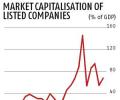
Forty years ago, the total market capitalisation of listed companies in the Indian stock market stood at a paltry seven per cent of gross domestic product (GDP). In 2012, the figure stood at 68 per cent.

Historically, overall credit has grown at 1.6 times GDP growth

The Asian Development Bank (ADB) on Wednesday slashed India's GDP growth forecast for FY23 to 7 per cent from the earlier estimate of 7.2 per cent mainly on account of higher inflation and a tight monetary policy. India's economy grew 13.5 per cent year-on-year in the first quarter of 2022-23, reflecting strong growth in services, ADB said in its second supplement to Asian Development Outlook Report 2022 (ADO 2022). "However, GDP growth is revised down from ADO 2022's forecasts to 7 per cent for FY2022 (ending March 2023) and 7.2 per cent for FY2023 (ending March 2024) as price pressures are expected to adversely impact domestic consumption, and sluggish global demand and elevated oil prices will likely be a drag on net exports," ADB said.

India, the world's fourth largest economy, is set to maintain the 'goldilocks' phase with tailwinds of good growth, low inflation and robust banking performance as well as reform initiatives poised to sustain the economic pace witnessed during 2025.

A State Bank of India report indicates a sharp increase in precautionary cash holding in India, with the gap between per capita currency in circulation and ATM withdrawals widening significantly, driven by global uncertainties despite record digital payment transactions.

'...especially pressure on the rupee, the current account deficit, and foreign exchange outflows.' 'The key question over the next several months is whether the government can prevent external turbulence from feeding into domestic economic pessimism.'

The deal shifts the US posture towards India from hostile to neutral, and that matters for growth, points out T T Ram Mohan.

As he projected a grim outlook for the economy, RBI Governor said that amidst this encircling gloom, agriculture and allied activities have provided a beacon of hope on the back of an increase of 3.7 per cent in foodgrains production to a new record.
India's economy grew 6.1 per cent in the fourth quarter of 2022-23, pushing up the annual growth rate to 7.2 per cent, official data showed on Wednesday.
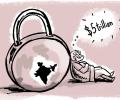
India will become the world's third largest economy by 2026 as its GDP in current dollar terms will reach $5 trillion in that year and further rise to $5.5 trillion in 2027, former Niti Aayog vice chairman Arvind Panagariya said on Friday. Delivering the 18th C D Deshmukh Memorial Lecture titled 'India at 125: Reclaiming the Lost Glory and Returning the Global Economy to the Old Normal', he said it is unlikely that GDP in current dollar terms of either Germany or Japan will cross $5 trillion-mark in the coming three years. Japan will have to sustain a growth rate of 3.5 per cent in current dollar terms to reach $5.03 trillion in 2027 from its 2022 level of $4.2 trillion, he said.

India's economy is expected to grow 6.4-6.7 per cent during the current financial year driven by strong domestic demand, even as geopolitical uncertainty poses downside risks, the newly appointed CII president Rajiv Memani said on Thursday.

'After the Galwan clash, the rules of engagement changed with the army commanders allowed to use any means at their disposal as they deem fit for tactical operations.'
"We forecast 7.3 per cent GDP growth (current financial year). We expect fundamentals to improve next year, propelling a recovery in H2 FY10," Lehman Brothers said in a report. For the first quarter ended June 2008, the economy registered a growth of 7.9 per cent against 9.2 per cent in the same period last year.

Morgan Stanley says, India will clock 7.9 per cent GDP growth in current fiscal.

India has expressed serious concerns about the West Asia crisis and its potential impact on energy supplies and maritime stability, urging BRICS nations to find practical solutions to geopolitical challenges and unilateral sanctions.

Benchmark equity indices Sensex and Nifty rebounded on Thursday after three sessions of losses, tracking gains in global markets after US President Donald Trump struck a conciliatory tone on Greenland. In a volatile session, the 30-share BSE Sensex climbed 397.74 points, or 0.49 per cent, to close at 82,307.37.

'The outlook for the next Samvat is more constructive, as many of the earlier drags are gradually becoming supports.'
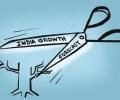
The Indian economy is estimated to grow at 7 per cent in the 2022-23 fiscal, down from 8.7 per cent a year ago, mainly due poor performance of mining and manufacturing sectors. As per the first advance estimates of national income released by the National Statistical Office (NSO) on Friday, the manufacturing sector output is estimated to decelerate to 1.6 per cent in the current fiscal from 9.9 per cent in 2021-22. Similarly, mining sector growth is estimated at 2.4 per cent in the current fiscal as against 11.5 per cent in 2021-22.

The country's gross domestic product (GDP) growth is likely to be 8.8 to 9 per cent in the current financial year, driven by agriculture and industry sectors, Care Ratings said in a report. The country's economy had contracted by 7.3 per cent in fiscal 2020-21. The agency said the outlook for the Indian economy on almost all counts in FY22 would look seemingly better than FY21 on account of the negative base effect.

The Indian government has implemented several measures to mitigate external risks, support the balance of payments, and maintain macroeconomic stability amidst the ongoing West Asia crisis, according to Minister of State for Finance Pankaj Chaudhary.

The Reserve Bank of India (RBI) on Friday delivered a 25 basis point (bps) repo rate cut analysts expected, driven by the strong 8.2 per cent GDP growth in the September quarter. However, analysts do not expect a runaway market rally as the impact of US tariffs continues.

While participants in the domestic financial market are expecting a 25 basis-point policy repo rate cut in the December meeting of the Monetary Policy Committee (MPC) of the Reserve Bank of India (RBI), economists remain torn between a reduction in rate cut and a pause.
India's Gross Domestic Product (GDP) is expected to expand by 9.2 per cent in the current financial year, according to the Economic Survey 2021-22 tabled in the parliament on Monday. "Advance estimates suggest that the Indian economy is expected to witness real GDP expansion of 9.2 per cent in 2021-22 after contracting in 2020-21. "This implies that overall economic activity has recovered past the pre-pandemic levels," Economic Survey noted. Almost all indicators show that the economic impact of the "second wave" in Q1 was much smaller than that experienced during the full lockdown phase in 2020-21 even though the health impact was more severe, it said.

Reserve Bank Governor Sanjay Malhotra on Friday said the key policy rates will remain at low levels for a long period and may go down even further.

If TVK MLAs and ministers are perceived as clean, or demonstrably cleaner than their predecessors, the credibility dividend will be enormous. The voter will feel rewarded, points out Ramesh Menon.

Trade deals ease risks for Indian equities, but weak demand and stretched valuations raise questions over whether optimism -- especially in smallcaps -- can turn into a sustained bull run, points out Debashis Basu.

Consequently, corporate India had shown downfall in terms of net profit margin in the fourth quarter of the financial year 2012-13.

In April, the World Bank had projected India's GDP would grow at 6.1 per cent in the current financial year and at 6.7 per cent the following year.
Morgan Stanley on Monday raised India's growth forecast for the current financial year to 5.4 per cent from 5.1 per cent projected earlier citing better than expected GDP growth in the September quarter and stabilisation in non-agriculture growth indicators.

Under the new methodology, the base year has been changed from 2004-05 to 2011-12 and also in conformity with the international practice, the GDP is now measured at market prices.

A below-normal monsoon can bring down India's GDP growth by 0.50-0.75 per cent this financial year, forcing the Reserve Bank to delay rate cuts to 2015, Bank of America-Merrill Lynch (BofA-ML) said.
